1. Introduction: The Sporting Dog Legacy

Both the Hungarian Vizsla and the Weimaraner are distinguished members of the American Kennel Club’s (AKC) Sporting Group, breeds originally developed for hunting game. They are renowned for their athleticism, intelligence, and the strong, often inseparable, bond they form with their human companions. The Vizsla, frequently referred to as the “Hungarian Pointer” or “Magyar Vizsla,” is instantly recognizable by its distinctive sleek, golden-rust coat. The Weimaraner, on the other hand, is famously nicknamed the “Gray Ghost,” a moniker derived from its unique silvery-gray coat and its stealthy, catlike hunting style.
The classification of both breeds within the Sporting Group immediately signals a fundamental aspect of their nature. This designation indicates that these dogs were historically bred for active roles in hunting, requiring and possessing significant athleticism, endurance, and a keen intelligence for fieldwork. This inherent design directly translates into a shared, profound need for substantial physical and mental stimulation in a companion setting. This is not a secondary characteristic but a core requirement for their well-being. Consequently, prospective owners must recognize that a sedentary lifestyle is fundamentally incompatible with either breed, and a failure to meet these intrinsic needs will inevitably lead to behavioral challenges and an unhappy dog. The Sporting Group affiliation, therefore, serves as an initial, critical filter for potential owners, highlighting the active commitment required.
This report aims to provide a comprehensive, expert-level comparison of these two popular breeds. It will delve into their historical development, physical attributes, inherent temperaments, extensive care requirements, training aptitudes, and suitability as family pets and companions. The overarching goal is to equip prospective owners with the detailed information necessary to make an informed decision about which breed, if either, best aligns with their lifestyle, experience, and expectations.
2. Historical Roots and Original Purpose
The historical breeding purpose of these dogs profoundly influences their modern-day temperament and physical requirements. Understanding their origins provides crucial context for their behavior and needs today.
The Hungarian Vizsla: Golden Rust Hunter
The lineage of the Vizsla traces back over a thousand years to the dogs of the Magyar tribes, who settled in present-day Hungary. Archeological findings, such as stone etchings, depict Magyar hunters accompanied by their falcons and dogs, illustrating the early partnership that would evolve into the modern Vizsla. For centuries, these regal canines were highly valued, considered the “most prized possession of aristocrats” within the Austro-Hungarian empire, earning them the alternative name “Hungarian Pointers”.
The Vizsla was meticulously bred to be a versatile gundog, proficient in both pointing out game and retrieving it from land and water. Their development on the expansive Hungarian plains favored a swift and cautious hunter, adept at working closely with humans without alerting quarry. They were utilized for hunting upland game, rabbits, and waterfowl. The breed faced two severe declines, first in the late 19th century and again after World War I, when records suggest only about a dozen purebreds remained. Fortunately, dedicated Vizsla enthusiasts committed to their preservation, leading to a remarkable resurgence in popularity across multiple countries. The breed’s importation into the United States commenced in the 1950s, culminating in its official recognition by the AKC in 1960. Demonstrating their inherent intelligence and adaptability, many contemporary Vizslas serve in diverse working roles, including guide dogs, sniffers for the Transportation Security Administration (TSA), and search-and-rescue dogs, notably participating in efforts after 9/11. Their versatility is further underscored by a Vizsla named Kai, who became the first AKC Triple Champion of any breed in 1980, excelling in show, field, and obedience.
The Weimaraner: Germany’s Gray Ghost
The Weimaraner originated in the early 19th century in Germany, specifically within the region of Weimar. The breed was developed under the patronage of the Grand Duke Karl August of Weimar, from whom it derives its name. It gained official breed recognition in 1891. Initially, Weimaraners were specifically bred to hunt large, formidable game such as bear, boar, deer, wolves, and mountain lions in the dense German forests. This demanding role necessitated exceptional tracking ability, athleticism, and sharp intellect. As large game populations dwindled, their utility shifted, and they transitioned to hunting smaller game like rabbits, foxes, and fowl. Historically, Weimaraners also served as guardians for homes. The Weimaraner arrived in the U.S. in the 1920s, but its popularity soared dramatically in the 1950s following a publicist-driven campaign that promoted them as a “super dog”. This exaggerated marketing unfortunately led to a surge in breeding, often with an emphasis on appearance over genuine hunting prowess, causing a subsequent decline in their reputation as versatile gun dogs. Despite this, a significant revival of their role as hunting dogs is currently underway in North America. Breeders are strategically combining field trial bloodlines with original German genetics to enhance traits such as range, speed, nose sensitivity, and hunting intensity. The breed was officially recognized by the AKC in 1943. Their striking appearance and loyal nature attracted prominent owners, including Hollywood icon Grace Kelly and President Dwight D. Eisenhower, further boosting their public profile. Weimaraners have also been famously featured as subjects in the artwork of photographer William Wegman. The consistent emphasis on the hunting heritage of both breeds is a critical factor influencing their modern-day characteristics. The Vizsla’s role as a pointer and retriever, and the Weimaraner’s evolution from large game hunter to versatile gundog, directly explain their inherent high energy levels, powerful prey drives, and an undeniable need for substantial physical and mental stimulation. These are not merely suggestions but deeply ingrained instincts. For prospective owners, this means these traits are not easily suppressed or trained away; rather, they require consistent and appropriate channeling through activities that mimic their natural drives. Neglecting these needs will almost certainly result in undesirable and destructive behaviors. The Weimaraner’s specific design as a “gentleman’s gun dog” also implies an “off switch” for indoor relaxation, a nuanced trait that suggests a capacity for settling down if its rigorous outdoor needs are met, potentially distinguishing it slightly from the Vizsla in terms of indoor demeanor.The historical near-extinction events for both breeds underscore their perceived intrinsic value and unique qualities that motivated dedicated fanciers to ensure their survival. This resilience speaks to the enduring appeal of their core characteristics. However, the Weimaraner’s dramatic surge in popularity in the 1950s, driven by exaggerated “super dog” claims from a publicist, serves as a cautionary tale. This period led to widespread overbreeding, often prioritizing appearance over health and working ability, which ultimately “plummeted” the breed’s reputation as a gun dog. This historical pattern highlights the critical importance for prospective owners to thoroughly research breeders, ensuring they prioritize health, temperament, and adherence to true breed standards rather than fleeting trends or superficial appeal.

3. Physical Characteristics: Form and Function
The physical attributes of the Vizsla and Weimaraner reflect their distinct origins and roles as hunting dogs, influencing their care and suitability for various environments.
Size and Weight Comparison
The Hungarian Vizsla is a medium-sized breed, characterized by a lean, athletic, and light-footed build. Males typically stand between 22 and 24 inches (57-64 cm) at the shoulder and weigh 55-60 pounds (20-27 kg). Females are slightly smaller, ranging from 21 to 23 inches (53-60 cm) in height and 44-55 pounds (20-25 kg) in weight. Their average lifespan is 12-14 years. The Weimaraner is considered a medium to large-sized dog, presenting a powerful and streamlined physique built for endurance and work. Males typically measure 25-27 inches (61-69 cm) at the shoulder and weigh 70-90 pounds (32-41 kg). Females are slightly smaller, standing 23-25 inches (56-64 cm) tall and weighing 55-80 pounds (25-36 kg). Their average lifespan is 10-13 years.
While both breeds fall into the medium-to-large category and are highly active, the Weimaraner’s greater size and weight necessitates slightly more physical space, potentially requiring larger living quarters and more robust fencing, especially given their known tendency to roam or unlatch gates. More critically, this size combined with their high energy and boisterous nature directly increases the risk of accidentally knocking over small children. This causal relationship is why Weimaraners are often better suited to households with adults and older children. This observation moves beyond simple dimensions to highlight the practical, safety-related implications of breed size within a family environment.
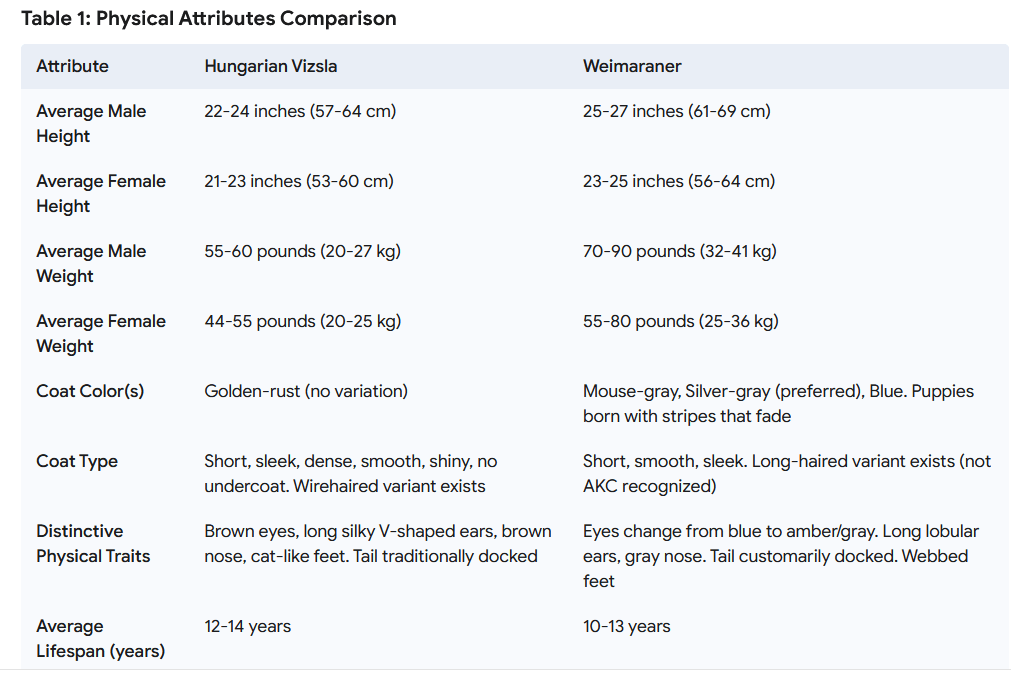
A wirehaired version, featuring a bulkier coat, hairy eyebrows, and a beard, was cross-bred in the 1930s with German Wirehaired Pointers to better suit colder climates. The Weimaraner is characterized by distinctive solid coat colors, including mouse-gray, silver-gray (preferred), or blue. Puppies are born with tiger stripes that completely fade within a few days. A small white mark on the chest is permissible, but blue or black coats are considered disqualifications in the show ring. The coat is short, smooth, and sleek. While a long-haired variety exists, it is not recognized by the AKC. The specific coat coloration of each breed is not accidental; it represents an evolutionary or deliberate breeding adaptation to enhance their hunting effectiveness in their respective environments. The Vizsla’s golden-rust tone allows it to blend into Hungarian landscapes, while the Weimaraner’s gray provides stealth in German forests. The shared trait of a short, sleek coat implies relatively lower grooming demands compared to long-haired breeds. However, the Vizsla’s lack of an undercoat means it offers less protection in colder climates, a factor addressed by the development of the wirehaired Vizsla. This connection between physical traits and historical function provides a deeper understanding of the breeds’ inherent capabilities and practical considerations for owners regarding climate suitability and overall grooming effort.
Distinctive Features
The Hungarian Vizsla features long, silky, V-shaped ears that are moderately low-set and hang close to the cheeks, framing a facial expression that is sensitive and loving at home yet intense when focused on work. Their eyes are medium-sized, slightly oval, and a shade darker than their coat. The nose is brown. The tail is traditionally docked by one-third in regions where it is legal; if undocked, it is moderately thick, slightly curved, and tapers towards the hocks. Cat-like feet are a desired trait.
The Weimaraner possesses long, lobular, slightly folded ears set high on the head. Their eyes undergo a captivating color change, transitioning from blue at birth to light amber, gray, or blue-gray as they mature. The nose is gray. The tail is customarily docked to cover the scrotum in males and vulva in females; if undocked, it is moderately set, tapers towards the tip, and reaches the hocks. A unique physical trait is their webbed feet, which contribute to their excellent swimming ability.
4. Temperament and Personality: Beyond the Hunt
The inherent temperament and personality of both the Vizsla and Weimaraner are deeply intertwined with their historical roles as close-working hunting companions. This common foundation leads to many similarities but also subtle yet important distinctions in their behavior and social dynamics.
Vizsla Traits
Vizslas are consistently described as “affectionate, loyal, energetic, gentle, and quiet”. They form exceptionally tight bonds with their owners and are known to “hate to be left alone”. Their strong desire to stay close to their humans has earned them the affectionate nickname “Velcro dogs”. They are demonstratively affectionate, craving human companionship. Highly intelligent, curious, and keen to learn, Vizslas excel at training. They possess a strong “eager-to-please” nature, which greatly aids in their trainability. However, their intelligence can sometimes manifest as manipulative behavior. They are high-energy dogs with abundant, “boundless energy” that requires significant outlets. Vizslas are noted as a sensitive breed that responds optimally to positive reinforcement training methods. Harsh punishments can be detrimental to their bond and learning process. They make good watchdogs and are quite vocal, often barking to alert their owners to new situations or strangers. They are generally friendly to strangers unless threatened.
Weimaraner Traits
Weimaraners are characterized as “intelligent, steady, powerful, aloof, alert, stubborn, energetic, and fast”. They are highly intelligent and learn rapidly, but can also bore quickly. This combination means they require consistent mental stimulation to prevent destructive behaviors. Weimaraners are deeply affectionate with their families, forming strong bonds and often described as “Velcro dogs” due to their desire for close human companionship. This intense devotion means they do not cope well when left alone for extended periods and are prone to separation anxiety, which can lead to depression, excessive barking, chewing, or escape attempts. While friendly with family, Weimaraners can be aloof and suspicious with strangers, making them excellent watchdogs. Their strong scenting abilities are legendary, with owners jokingly calling it “cheating” to enter tracking events with them. They have a powerful prey drive, which means they are likely to chase or injure small animals like cats, rodents, birds, or small dogs, necessitating careful management and socialization. They can be strong-willed and test boundaries, requiring firm, consistent, and patient training. The strong bond both breeds form with their owners, often leading to the “Velcro dog” designation, is a direct consequence of their historical role as close-working hunting companions. Unlike independent hunting breeds, Vizslas and Weimaraners were bred to work with their human partners, necessitating a high degree of attentiveness and a desire for proximity. This deep attachment, while endearing, carries a significant implication: a high predisposition to separation anxiety if their need for companionship is not met. This is not merely a behavioral quirk but a welfare concern that prospective owners must address through appropriate training, lifestyle adjustments, and ensuring the dog is not left alone for extended periods. Understanding this causal link between historical function and modern behavioral challenges is crucial for responsible ownership.
5. Exercise and Activity Needs
Both Vizslas and Weimaraners are high-energy dogs that require substantial physical and mental exercise to remain healthy and well-behaved. Their athletic builds and hunting heritage mean that insufficient activity can lead to boredom and destructive behaviors.
Vizsla Exercise Needs
Vizslas are active hunting dogs that need both physical and mental stimulation. Owners should plan for a minimum of 30 minutes of active exercise daily, though many individuals will require more. Some sources recommend at least 1-2 hours of vigorous activity each day. This includes regular leash walks, games of fetch, and crucial opportunities to run hard off-leash in a secure area. Vizslas excel in various dog sports such as agility, obedience, rally, dock diving, barn hunts, lure coursing, scent work, tracking, and field trials. They are excellent running or jogging companions, though young dogs should not engage in long distances until they reach maturity at 18 to 24 months. Older Vizslas typically remain active and playful. Mental exercise, through training and interactive games, is as important as physical activity to prevent boredom and destructive behaviors like chewing and digging.
Weimaraner Exercise Needs
Weimaraners are also high-energy dogs with boundless stamina, requiring a significant amount of daily exercise. They need at least 2 hours of vigorous exercise every day to keep them physically and mentally stimulated. This can include running, jogging, hiking (up to 20 miles for healthy Weimaraners), and playing fetch in securely enclosed areas. Some Weimaraners have even accompanied owners on marathons. Regular exercise not only helps them burn off energy but also prevents behavioral problems that may arise from boredom or pent-up energy. Their strong prey drive means off-lead exercise should be conducted in safe, controlled environments. Weimaraner puppies require careful exercise management to avoid injury to their growing bodies, with controlled play sessions and short walks gradually increasing in intensity as they mature. Weimaraners love water and are naturally strong swimmers. Mental stimulation through puzzle games and challenging activities is crucial for this intelligent breed.
The significant exercise requirements for both breeds are a direct consequence of their historical roles as working gundogs. These animals were selectively bred for endurance, speed, and the ability to work for long periods in the field. Therefore, their high energy levels are not merely a characteristic but a fundamental aspect of their physiological and psychological makeup. For owners, this translates into a non-negotiable commitment to providing substantial daily physical activity, far beyond simple leash walks. Failure to meet these innate needs will not only result in pent-up energy but will manifest as destructive behaviors such as chewing, digging, and excessive barking, as the dogs attempt to find outlets for their unspent drive. This connection highlights that managing these breeds is less about “training out” high energy and more about “channeling” it appropriately through consistent, vigorous activity.
6. Training Aptitude and Methods
Both Vizslas and Weimaraners are highly intelligent breeds with a strong desire to learn, making them generally responsive to training. However, their sensitivity and energy levels dictate specific approaches for effective results.
Vizsla Training Aptitude
Vizslas are highly intelligent, curious, and eager to please, which makes them generally easy to train. They thrive on attention and affection, and their responsiveness to positive reinforcement is crucial. This breed responds exceptionally well to praise, treats, and affection as rewards for good behavior. The focus should be on rewarding positive actions rather than punishing negative ones, as harsh punishments can damage the bond and hinder their learning process. Consistency is vital in training Vizslas; establishing a regular schedule and ensuring all family members use the same commands prevents confusion. Early socialization is essential for them to develop into well-adjusted adults, involving gradual introductions to various people, animals, and environments. Enrolling them in socialization classes provides positive experiences and teaches basic commands, helping to avoid behavioral problems and fostering confidence. Mental stimulation through interactive toys, puzzle feeders, and games like hide-and-seek is necessary to keep their minds sharp and engaged, enhancing training effectiveness.
Weimaraner Training Aptitude
Weimaraners are intelligent and eager to please, which makes them generally responsive to training. They have a strong desire to learn and excel in various dog sports, including obedience, agility, and tracking. However, they can be strong-willed and stubborn, requiring a persistent and patient trainer. Early socialization and positive reinforcement training methods are crucial for their development. They respond best to rewards, praise, and consistent, patient training techniques. Harsh or punitive methods should be avoided due to their sensitive nature. Engaging their minds through mental stimulation and interactive training sessions helps prevent boredom and encourages focus. Basic commands like “sit” and “heel” are foundational, taught using treats and verbal praise. Clicker training is also an effective positive reinforcement method. Weimaraners benefit from exposure to different people and dogs from a young age to build confidence and prevent wariness or aggression. Crate training is recommended to prevent destructive behaviors when left alone and to manage separation anxiety.
The high intelligence and eagerness to please observed in both breeds mean that they are highly trainable, but this trainability comes with a critical caveat: they are also adept at picking up unwanted habits if not properly stimulated and guided. Their quick learning ability means that any inconsistency in training or lack of mental engagement can rapidly lead to undesirable behaviors. This highlights the importance of proactive, consistent, and engaging training from puppyhood. Furthermore, their sensitivity, particularly noted in Vizslas, indicates that harsh training methods are not only ineffective but can be detrimental to their bond with humans and their overall psychological well-being. This necessitates a reliance on positive reinforcement techniques, which foster trust and cooperation, rather than fear.
7. Grooming Requirements
Both the Vizsla and Weimaraner possess short, sleek coats that are relatively low-maintenance compared to many other breeds, but they still require regular care to maintain coat health and manage shedding.
Vizsla Grooming Needs
Vizslas have a short, sleek coat with no undercoat, which simplifies their grooming routine. They are considered “very clean” dogs. While they do shed, it is generally considered moderate year-round, with heavier shedding occurring during seasonal changes (spring and fall). Occasional brushing, at least once a week, with a rubber grooming brush, slicker brush, or grooming mitt helps remove loose hair, dirt, and debris, and distributes natural oils to keep the coat healthy and shiny. Bathing is typically infrequent, usually only when they get particularly dirty or roll in something smelly; an occasional bath every few months (e.g., every 3-4 months or every 6-8 weeks) with a good-quality dog shampoo is sufficient. Regular nail trimming is important to prevent overgrowth, which can lead to discomfort. Their ears should be checked frequently for dirt, wax build-up, or irritation, and cleaned regularly with a mild ear-cleaning product to prevent problems. Regular dental cleaning with dog-specific toothpaste is also recommended for oral health.
Weimaraner Grooming Needs
The Weimaraner’s coat is short, smooth, and sleek, often described as “wash and wear”. While they shed year-round, they are not considered heavy shedders. Weekly brushing with a rubber curry brush, hound glove, or soft-bristle brush is recommended to remove loose fur and dander, stimulate the skin, and distribute natural oils. During peak shedding seasons, brushing frequency may need to increase.
Bathing is infrequent, typically every few months (e.g., every 3-4 months or 4-6 weeks) or as needed when they are particularly dirty, using a gentle dog shampoo. Weimaraners are known to roll in smelly patches of ground, necessitating baths to remove odors. Regular nail trimming, approximately once a month or every 4-6 weeks, is crucial to prevent discomfort and potential health issues from overgrown nails. Due to their floppy ears, Weimaraners are prone to ear infections, so weekly checking and cleaning with a vet-approved ear cleaner is essential. Regular dental hygiene is also important. The short, smooth coats of both breeds, while low-maintenance, are not entirely “shed-free.” The expectation of minimal grooming, particularly for the Vizsla’s lack of an undercoat, does not negate the reality of year-round shedding, which intensifies seasonally. This means that while complex grooming procedures are avoided, regular brushing is still necessary to manage loose hair and maintain coat health, impacting household cleanliness. Furthermore, the vulnerability of their pendulous ears to infection in both breeds highlights a specific, ongoing care requirement that owners must consistently address. This detail moves beyond general grooming to pinpoint a common health susceptibility tied to their physical conformation, requiring proactive attention.
8. Family Suitability and Living Environment
The suitability of either breed as a family pet and their ideal living environment are heavily influenced by their high energy levels, strong prey drives, and profound need for human companionship.
Vizsla Family Suitability
Vizslas are affectionate, loyal, and gentle dogs that can make great family pets, especially for active owners. They form strong bonds with their families and thrive on human interaction. Because of their playful and boisterous nature, they generally get along well with older children who can engage in play, but their size and energy mean they might accidentally knock over very young children. Supervision is always recommended when dogs and children interact.
Vizslas are sociable by nature and generally tolerate other dogs and even cats well if properly socialized from a young age. However, their strong hunting heritage and prey drive mean that smaller pets like rodents, birds, or reptiles should be kept away, as Vizslas are liable to kill such animals. They make good watchdogs and are not typically excessive barkers, though they can be vocal to alert owners. Well-socialized Vizslas are friendly towards strangers unless threatened.
Weimaraner Family Suitability
Weimaraners are friendly, loyal, and affectionate dogs that form strong bonds with their families, often earning the “Velcro dog” moniker. They can be excellent companions for active households. While generally friendly and outgoing with children, their large size and high energy mean they might accidentally knock over small children, making them better suited for households with adults and older children. Supervision is always recommended with children. Their strong hunting instinct and prey drive make them likely to chase or injure small animals such as cats, rodents, and small dogs. While they may get along with other dogs if socialized from an early age, a lack of proper socialization can lead to dominant or aggressive behaviors. Weimaraners are watchful and alert, making them admirable watchdogs who will bark at strangers without being vicious.
Weimaraners, like Vizslas, do not cope well when left alone for extended periods and are highly susceptible to separation anxiety. Prolonged solitude can lead to excessive barking, destructive chewing, or attempts to escape. Crate training is often recommended to manage destructive behaviors when owners are away. They are not ideal for first-time dog owners without a dedicated training plan and resources. The shared susceptibility to separation anxiety in both breeds is a profound implication of their deep-seated need for human companionship, stemming from their close-working hunting heritage. These dogs were not bred for independent work but for partnership, fostering an intense reliance on human presence. Therefore, the development of separation anxiety is not a mere behavioral issue but a direct consequence of failing to meet this fundamental need for connection. This means that owners must be prepared to integrate these dogs fully into their daily lives, providing consistent interaction and minimizing prolonged periods of solitude, as failure to do so will inevitably lead to distress and destructive coping mechanisms.
9. Common Health Issues and Lifespan
Both Vizslas and Weimaraners are generally healthy breeds, but like all purebred dogs, they are predisposed to certain genetic conditions and health concerns that prospective owners should be aware of.
Hungarian Vizsla Health
The average lifespan of a healthy, well-bred, and well-cared-for Vizsla is between 12 and 14 years. As a medium-sized dog, they generally live longer than many large and extra-large breeds. While typically healthy, Vizslas are predisposed to certain conditions. Responsible breeders should screen their dogs for these issues to reduce the risk of genetic conditions.
Common health concerns for Vizslas include:
Canine Epilepsy: A brain condition causing seizures.
Joint Problems: Notably hip dysplasia, a degenerative joint disease where the hip joint doesn’t fit correctly, potentially leading to arthritis later in life.
Eye Disorders: Such as entropion (eyelids turn inward, irritating the eye) and progressive retinal atrophy.
Autoimmune Conditions: Vizslas are more likely to develop conditions where their immune systems attack their own cells.
Cancer: While all dogs are at risk, Vizslas have a higher risk of developing certain cancers at an earlier age, including lipoma, mast cell tumors, hemangiosarcoma, and lymphoma.
Allergies: Seasonal allergies are common.
Hyperuricosuria (HUU): A condition causing bladder stones.
Other reported conditions: Melanosis, ear infections, hypothyroidism, persistent right aortic arch (PRAA), dwarfism, tricuspid valve dysplasia, and lymphosarcoma.
Preventative healthcare, including regular vet check-ups, a balanced diet, and adequate exercise, is crucial for their longevity. Genetic testing for conditions like cerebellar cortical degeneration and exercise-induced collapse can assist in diagnosis and proactive care.
Weimaraner Health
The average lifespan of a healthy Weimaraner is 10 to 13 years, with some living as long as 15 years. As a large, purebred dog, Weimaraners are susceptible to several serious health issues. Common health concerns for Weimaraners include:
Stomach Bloat (Gastric Dilatation-Volvulus or GDV): A sudden, life-threatening condition where the stomach enlarges with gas and can twist on itself. Deep-chested, large breeds like Weimaraners are prone to this, and it requires emergency surgery. A gastropexy procedure can prevent the stomach from twisting.
Hip Dysplasia and Elbow Dysplasia: Degenerative joint diseases affecting the hind and front limbs, common in large breeds, leading to pain and arthritis. Testing like PennHIP can predict risk.
Eye Diseases: Including entropion (eyelids turn inward).
Hypothyroidism: An endocrine disease where the body functions slow down due to a lack of thyroid hormones.
Allergies: Common skin irritations.
Cancer: Weimaraners are at risk for various cancers.
Autoimmune Diseases:.
Cryptorchidism: Undescended testicles.
Other reported conditions: Degenerative myelopathy, progressive rod-cone degeneration, Von Willebrand’s Disease, distichiasis, hypomyelination and tremors, hyperuricosuria, and spinal dysraphism.
As you can see both breeds are great human companion and of great character.
Our friends have weimaraner and he is the greatest pup Phoebe loves hanging out with. They are very proud breeds: loving and caring.
Let us know what you think in comments!

 PawDeal
Leave a comment